
Your Body Was Designed for Variety — Not Just Exercise
Heather Otterbine
June 1, 2026
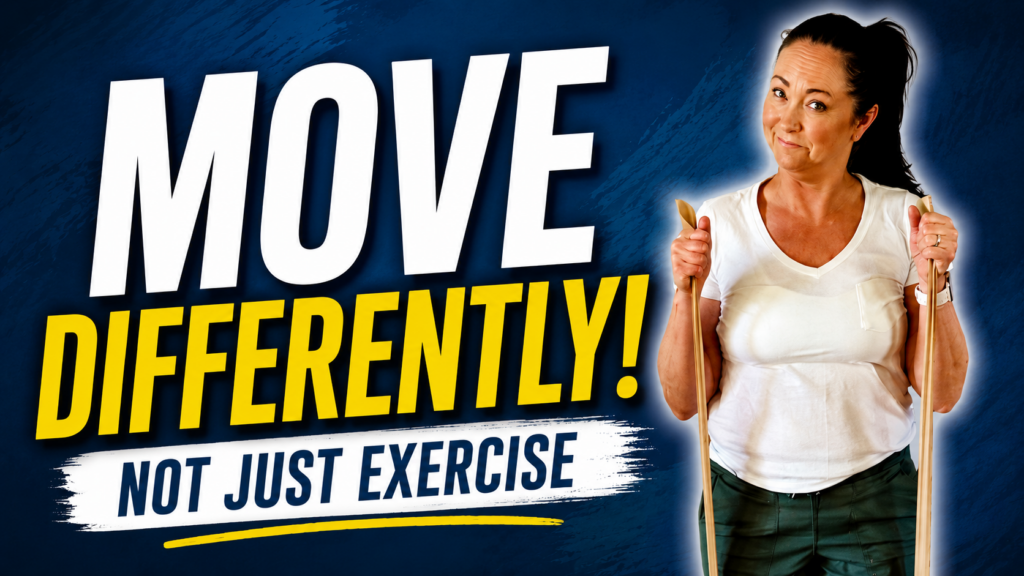
Most people think about movement in terms of exercise.
We ask questions like:
- How many steps should I walk?
- How many days should I strength train?
- How often should I stretch?
- What’s the best workout for healthy aging?
And while those are all worthwhile questions, I think there’s a much bigger conversation that often gets overlooked.
Our bodies weren’t designed simply to exercise.
They were designed to adapt.
Real Life Is Variable
Think about your average day.
You might carry groceries from the car.
Reach into a cabinet.
Step over a sleeping dog.
Walk across uneven grass.
Turn quickly when someone calls your name.
Climb stairs while carrying a laundry basket.
Get down on the floor to play with a child or grandchild.
None of those activities happen in a perfectly controlled environment.
Real life is constantly changing.
And our bodies and nervous systems are designed to respond to those changes.
The problem is that modern life often doesn’t provide many opportunities to practice adaptability.
The Challenge of Modern Movement
Many of us spend hours each day sitting.
We drive.
We work at desks.
We look at screens.
We move in the same patterns over and over again.
Even our exercise routines can become highly repetitive.
We walk the same route.
Use the same machines.
Perform the same workouts.
Repeat the same movement patterns week after week.
Now, don’t misunderstand me.
Strength training matters.
Walking matters.
Yoga matters.
Pilates matters.
I teach many of these things myself.
But I believe our bodies need more than repetition alone.
They also need variability.
They need opportunities to coordinate, stabilize, react, adjust, and adapt.
Your Nervous System Learns Through Experience
One of the most remarkable things about the human body is that the nervous system is always learning.
Every movement experience provides information.
When we challenge ourselves with slightly different movement experiences, we give our nervous system opportunities to develop:
- Better balance
- Better coordination
- Faster reactions
- Greater confidence
- Improved adaptability
Over time, these experiences help us build movement capacity.
And movement capacity becomes increasingly important as we age.
The Difference Between Being Fit and Being Capable
This is a distinction I think about often.
Someone can exercise regularly and still struggle with certain real-life movement demands.
They may find it difficult to:
- Walk confidently on uneven terrain
- React quickly to a loss of balance
- Carry awkward loads
- Get up and down from the floor
- Move efficiently in unpredictable environments
That doesn’t mean they’re failing.
It simply means they may need broader movement experiences.
Fitness is valuable.
But fitness alone is not the same thing as capability.
Why This Matters for Healthy Aging
As I’ve gotten older, my perspective on movement has shifted.
Healthy aging is no longer about chasing fitness trends or pursuing perfection.
It’s about maintaining the ability to participate fully in life.
I want to continue hiking.
Traveling.
Working.
Teaching.
Playing.
Exploring.
Learning.
I want to continue saying “yes” to experiences because my body is capable of supporting the life I want to live.
That’s what functional movement means to me.
Not fancy exercises.
Not circus tricks.
Not perfection.
Capacity.
Small Changes Make a Big Difference
The good news is that movement variability doesn’t require complicated workouts.
Often, it begins with small choices.
You might:
- Practice balancing while brushing your teeth.
- Get up and down from the floor more often.
- Carry groceries instead of always using a cart.
- Rotate your body more frequently throughout the day.
- Walk while occasionally changing your gaze or direction.
- Explore different movement patterns instead of always doing the same thing.
Small moments of variability add up.
Over time, they help keep the body adaptable.
And adaptability is one of the most valuable skills we can maintain as we age.
Exercise Is Practice for Life
This may be the most important idea I can share.
Exercise is not the goal.
Exercise is practice.
The goal is living.
The goal is building a body that supports the activities, experiences, and relationships that matter most to you.
Because your body was designed for more than rigid repetition.
It was designed to adapt.
Reflection Question
What’s one activity you want to continue doing confidently as you age?
Take a moment to think about it.
Your answer might reveal exactly why maintaining movement capacity matters so much.
Want to learn more about Functional Movement and Healthy Aging?
Subscribe to my YouTube channel and join me as we explore strength, mobility, balance, resilience, and the skills that help us continue participating fully in life.
YouTube Channel: @withheatherombodies
Similar Posts
October 26, 2026
What Happens When Life Stops Challenging Your Body?
The hidden tradeoff of convenience—and why keeping your options open matters as you age. We’ve gotten remarkably good at making life easier. We invented cars so we wouldn’t have to...

October 22, 2026
Yoga Teachers: Stop Confusing Popularity With Skill
Yoga Teachers: Stop Confusing Popularity With Skill Why a full classroom isn’t proof of excellent teaching—and an empty mat isn’t proof of failure. Some of the best yoga teachers I’ve...
October 19, 2026
Why Was This Getting Harder? Maybe Discipline Wasn’t the Problem.
There was a time when I was teaching ten to eighteen yoga and Pilates classes every week. I was active. I exercised regularly. I ate well. I understood the importance...

October 15, 2026
Your Yoga Practice Is Not Your Teaching Qualification
What your personal practice demonstrates—and what it doesn’t tell us about your ability to teach. Yoga teachers, can we talk about something that’s been kinda bugging me for years? Why...

October 12, 2026
Feeling Fine Isn’t the Same as Being Prepared
“I’ll worry about it when I have to.” I’ve heard people say that about their health and physical abilities for years. And I understand it. When nothing hurts and you’re...

October 8, 2026
Yoga Teachers, You Need Better Questions.
What if becoming a more confident yoga teacher isn’t about having more answers, but learning to ask better questions? 🎥 Prefer to watch? Sometimes the most useful thing a yoga...

October 5, 2026
Your Life Might Be Getting Easier—And That’s Not Always Good News
Your life might be getting easier. And that sounds like a good thing, right? In a lot of ways, it absolutely is. We have groceries delivered to our doors. We...
October 1, 2026
Knowing Anatomy Isn’t Enough: What Makes a Better Yoga Teacher?
You can know a whole lot of anatomy and still not know what to do with the person standing in front of you. Imagine you’re teaching a yoga class and...

September 27, 2026
Life Changes the Assignment: Is Your Body Ready?
Why preparing your body for everyday life means building more physical capacity than you currently need. 🎬 Prefer to Watch? Sometimes it’s easier to see an idea come to life...
September 23, 2026
A Good Yoga Teacher Doesn’t Need to Have All the Answers
A Good Yoga Teacher Doesn’t Need to Have All the Answers Has a student ever said something like: “I feel something weird in my knee when I do this.” And...