
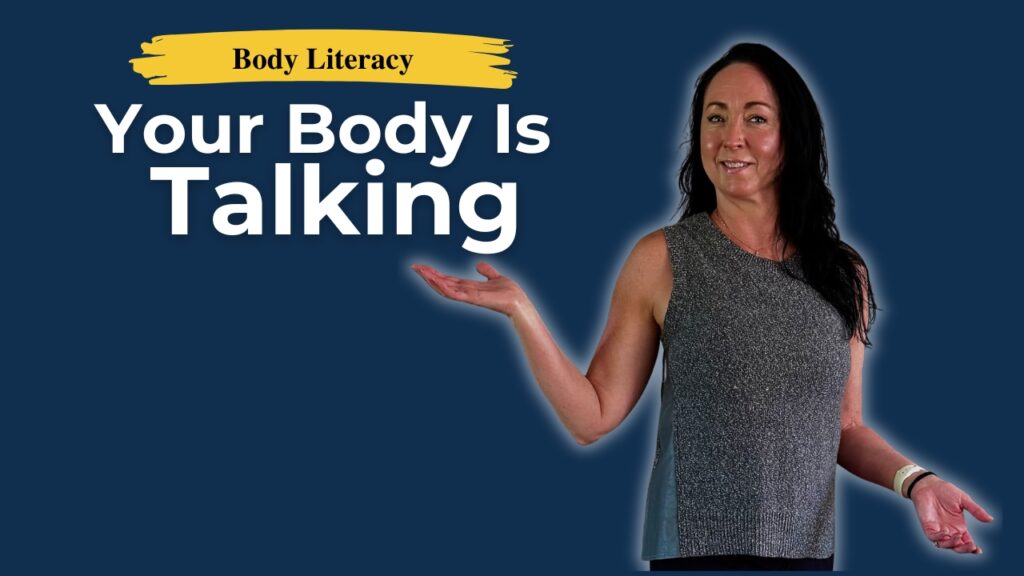
Your Body Is Talking. Are You Listening?
Heather Otterbine
July 13, 2026
Most of us were taught how to exercise. Very few of us were taught how to understand our bodies.
Have you ever noticed how one part of your body keeps hurting…but treating that spot never seems to solve the problem?
Maybe you’ve stretched your shoulders for weeks only to realize the tightness keeps returning.
Maybe your knees complain every time you walk downstairs.
Maybe you wake up feeling stiff one morning and surprisingly energetic the next.
Our first instinct is often to ask:
“How do I fix this?”
But what if there’s a better question?
“What is my body trying to tell me?”
That question is where Body Literacy begins.
What Is Body Literacy?
Body Literacy is the ability to notice patterns, understand what your body is communicating, and make thoughtful decisions based on that information.
It’s not about becoming an anatomy expert.
You don’t need to memorize every muscle, ligament, or bone.
Instead, it’s about becoming more fluent in the language your body has been speaking all along.
Your body is constantly providing feedback.
It tells you when you’re recovering well.
It tells you when you’ve been sitting too long.
It tells you when stress is affecting the way you move.
It tells you when something deserves a little more attention.
The challenge isn’t that our bodies are silent.
The challenge is that most of us have never learned how to listen.
Becoming Curious Instead of Critical
One of the biggest shifts that happens as you develop Body Literacy is changing your internal dialogue.
Instead of saying:
“My back is bad.”
You begin asking:
“I wonder why my back is talking to me today?”
That single question changes everything.
Curiosity opens the door to understanding.
Judgment usually closes it.
Your Body Works as One Connected System
Imagine your shoulder hurts.
It’s tempting to assume the shoulder is the problem.
Sometimes it is.
But sometimes your shoulder is simply the place that’s asking for help.
Maybe your upper back has become stiff.
Maybe your rib cage isn’t moving well.
Maybe you’ve been sitting at your computer more than usual.
Maybe stress has left your muscles working overtime.
Maybe you’ve changed the way you’ve been sleeping.
The shoulder isn’t isolated from the rest of you.
Neither is your low back.
Neither are your knees.
Our bodies are remarkably interconnected.
That’s why simply chasing symptoms doesn’t always lead to lasting change.
Your Body Is Always Giving You Information
Pain is information.
Fatigue is information.
Balance is information.
Recovery is information.
Energy is information.
None of these signals are good or bad.
They’re simply messages.
Learning to recognize those messages early allows us to make small adjustments before little problems become much bigger ones.
Why Body Literacy Matters More As We Age
As we grow older, our bodies continue communicating with us.
A little hesitation getting off the floor.
A slight decrease in confidence walking on uneven ground.
A bit more stiffness after gardening.
Needing a little longer to recover after a busy weekend.
These aren’t reasons to panic.
They’re opportunities to pay attention.
The earlier we notice changes, the more options we usually have for responding.
That’s one of the reasons I believe healthy aging isn’t about trying to stop aging.
It’s about learning to work with your body instead of constantly fighting against it.
The Beginning of a Different Conversation
One of the reasons I created The EveryDay Athlete is because I believe every one of us deserves to better understand the body we live in.
Body Literacy isn’t about perfection.
It’s about paying attention.
It’s about asking better questions.
It’s about recognizing patterns before they become problems.
And perhaps most importantly…
It’s about replacing fear with understanding.
Because once you begin listening to your body, you’ll never think about movement in quite the same way again.
Watch the Video
In this week’s YouTube video, we explore what Body Literacy is, why it matters, and how learning to recognize your body’s signals can completely change the way you move and age.
Similar Posts

October 26, 2026
What Happens When Life Stops Challenging Your Body?
The hidden tradeoff of convenience—and why keeping your options open matters as you age. We’ve gotten remarkably good at making life easier. We invented cars so we wouldn’t have to...

October 22, 2026
Yoga Teachers: Stop Confusing Popularity With Skill
Yoga Teachers: Stop Confusing Popularity With Skill Why a full classroom isn’t proof of excellent teaching—and an empty mat isn’t proof of failure. Some of the best yoga teachers I’ve...
October 19, 2026
Why Was This Getting Harder? Maybe Discipline Wasn’t the Problem.
There was a time when I was teaching ten to eighteen yoga and Pilates classes every week. I was active. I exercised regularly. I ate well. I understood the importance...

October 15, 2026
Your Yoga Practice Is Not Your Teaching Qualification
What your personal practice demonstrates—and what it doesn’t tell us about your ability to teach. Yoga teachers, can we talk about something that’s been kinda bugging me for years? Why...

October 12, 2026
Feeling Fine Isn’t the Same as Being Prepared
“I’ll worry about it when I have to.” I’ve heard people say that about their health and physical abilities for years. And I understand it. When nothing hurts and you’re...

October 8, 2026
Yoga Teachers, You Need Better Questions.
What if becoming a more confident yoga teacher isn’t about having more answers, but learning to ask better questions? 🎥 Prefer to watch? Sometimes the most useful thing a yoga...

October 5, 2026
Your Life Might Be Getting Easier—And That’s Not Always Good News
Your life might be getting easier. And that sounds like a good thing, right? In a lot of ways, it absolutely is. We have groceries delivered to our doors. We...

October 1, 2026
Knowing Anatomy Isn’t Enough: What Makes a Better Yoga Teacher?
You can know a whole lot of anatomy and still not know what to do with the person standing in front of you. Imagine you’re teaching a yoga class and...

September 27, 2026
Life Changes the Assignment: Is Your Body Ready?
Why preparing your body for everyday life means building more physical capacity than you currently need. 🎬 Prefer to Watch? Sometimes it’s easier to see an idea come to life...

September 23, 2026
A Good Yoga Teacher Doesn’t Need to Have All the Answers
A Good Yoga Teacher Doesn’t Need to Have All the Answers Has a student ever said something like: “I feel something weird in my knee when I do this.” And...