
Yoga Teachers: Stop Confusing Popularity With Skill
Heather Otterbine
October 22, 2026
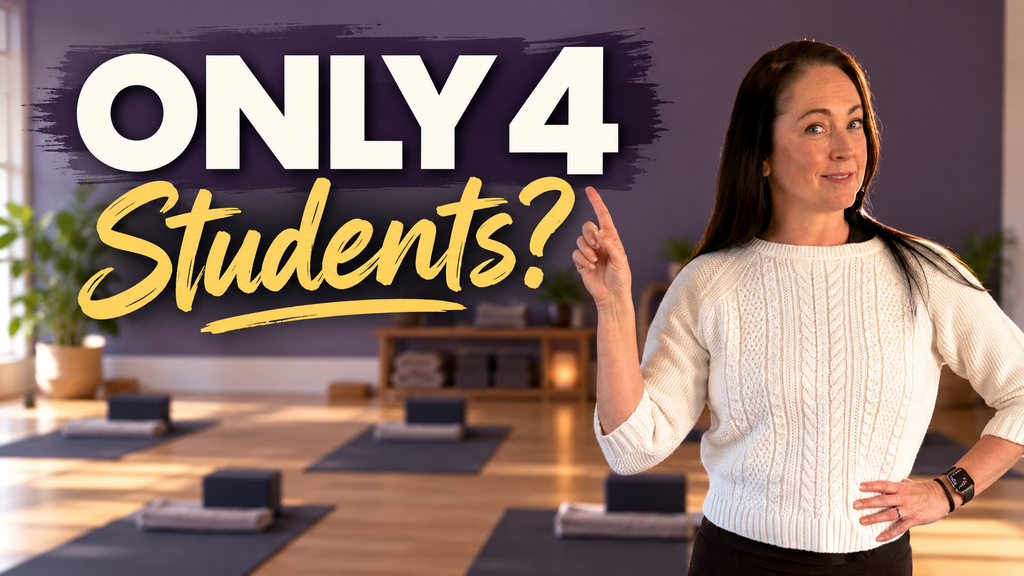
Yoga Teachers: Stop Confusing Popularity With Skill
Why a full classroom isn’t proof of excellent teaching—and an empty mat isn’t proof of failure.
Some of the best yoga teachers I’ve ever studied with are people you’ve probably never heard of.
And some of the most popular yoga teachers I’ve studied with have been absolutely exceptional.
Because here’s something I’ve been telling my teacher trainees for years:
A popular yoga teacher is not necessarily a good yoga teacher. And a good yoga teacher is not necessarily a popular yoga teacher.
Those are two different things.
But somewhere along the way, I think we’ve started confusing them.
And that confusion isn’t just affecting how we evaluate other teachers. It’s affecting how we evaluate ourselves.
When Four Students Feel Like a Failure
Imagine you’ve just finished teaching a yoga class.
You prepared thoughtfully. You paid attention to the students in front of you. You offered useful instruction, made adjustments when necessary, and created an experience that supported what you intended to teach.
But only four people showed up.
Instead of reflecting on what happened during the class, you find yourself thinking about everyone who wasn’t there.
Maybe I’m not a very good teacher.
Maybe people don’t like my classes.
Maybe I need another certification.
And sometimes it’s not even your own disappointment that bothers you most. It’s what you imagine everyone else is thinking.
The studio owner. Your fellow teachers. Maybe even those four students.
Meanwhile, another teacher across town has twenty-five students in her class.
And almost immediately, you’ve decided she must be doing something better than you.
But what do you actually know about the quality of either class?
Not much.
You know how many people attended.
That’s an attendance number. It’s not an evaluation of teaching proficiency.
Popularity and Teaching Skill Are Different Competencies
I owned a yoga studio for years. I understand the importance of attracting students, filling classes, and building a financially sustainable business.
Those things matter.
But being successful at attracting students and being skilled at teaching students are not the same competency.
Sometimes those abilities overlap beautifully.
Sometimes they don’t.
A yoga teacher might be extraordinarily skilled at observing movement, communicating clearly, adapting to individual needs, and helping students develop a deeper understanding of their bodies.
And she might be terrible at marketing herself.
Another teacher might be exceptionally good at building an audience, creating engaging content, and attracting students.
That doesn’t automatically tell us whether she’s an effective educator.
Neither situation tells the whole story.
Yet we regularly treat attendance numbers, sold-out workshops, and social media followers as though they’re evidence of teaching proficiency.
They’re not.
They’re indicators of visibility, demand, and business performance.
Those are valuable things to understand. But they measure something different.
What Actually Makes Someone a Good Yoga Teacher?
After more than twenty years of teaching yoga and thousands of hours invested in my own education, I’ve studied with teachers whose names are widely recognized.
I’ve also studied with extraordinary educators who have relatively little public visibility.
What made those learning experiences valuable wasn’t the teacher’s popularity.
It was what happened during the learning experience.
Did they explain something in a way that changed my understanding?
Did they challenge an assumption I’d been carrying?
Did they help me recognize something I hadn’t noticed before?
Could I take what I’d learned and apply it to my own teaching?
That’s the distinction between being impressed by someone and actually learning from them.
When I evaluate teaching proficiency, I’m interested in questions like these:
- Can the teacher communicate clearly and meaningfully?
- Can they observe the students in front of them rather than rely exclusively on memorized instructions?
- Can they recognize when an approach isn’t working?
- Can they make useful adjustments and explain their reasoning?
- Are they willing to question their own assumptions and continue learning?
A teacher can demonstrate those abilities exceptionally well with four students in the room.
Or struggle with them in a room of forty.
The number of people watching doesn’t determine the quality of the teaching.
Are You Trying to Solve the Wrong Problem?
Here’s where confusing popularity with proficiency can become particularly frustrating.
You want more students.
That’s reasonable. You want your classes to be sustainable, and you want to reach people who could benefit from what you teach.
But when attendance is low, you begin questioning your abilities.
So you sign up for another training.
Learn another sequence.
Add another certification.
Try to make your classes more impressive.
And sometimes additional education is exactly what you need.
But sometimes your teaching isn’t the problem.
Maybe your class is scheduled at a time that doesn’t work for your intended audience.
Maybe people don’t know it exists.
Maybe your messaging doesn’t clearly communicate what students can expect.
Maybe you’re simply not reaching the people who would appreciate your approach.
You can’t solve a visibility problem by automatically assuming you have a competency problem.
And the reverse is also true.
You can’t solve a competency problem simply by filling more mats.
Those are different problems, and they require different solutions.
Before deciding what needs improvement, you need to understand what you’re actually trying to improve.
A Better Way to Evaluate Your Teaching
The next time you finish teaching, before you look at attendance numbers or compare your class to someone else’s, consider three things.
1. Your intention
What were you trying to help students explore, understand, or develop?
Did your instruction support that intention?
A thoughtfully designed class should have a purpose beyond simply moving students through a sequence.
2. Your observations
What did you notice about the people in front of you?
Did you recognize when something wasn’t working as intended?
Were you responding to what you actually observed, or relying on what you expected to see?
3. Your decisions
What adjustments did you make?
Why did you make them?
What happened afterward?
And what might you approach differently next time?
These questions won’t tell you everything about your teaching. Student feedback, continuing education, and reflection over time all contribute to professional development.
But they’re a much more useful starting point than deciding whether you’re a good teacher based on how many people showed up.
They direct your attention toward the skills you can actually examine and develop.
Four Students Are Still Four Opportunities to Teach Well
Let’s return to that classroom.
Four students showed up.
Not twenty. Not forty.
Four.
Maybe you’re disappointed. Maybe you hoped more people would come.
I understand that.
But those four students are there.
They’re giving you their time, their attention, and their trust.
What are you doing with that opportunity?
Because that’s where your teaching happens.
Not in the attendance report.
Not in your follower count.
And not in comparison with the teacher across town.
A full classroom doesn’t automatically make you an excellent teacher.
And a half-empty classroom doesn’t make you a bad one.
Your teaching deserves a better evaluation than a headcount.
And if you want to become a better teacher, start by examining what you’re actually doing with the people in front of you.
Watch: Stop Confusing Popularity With Skill
In this week’s video, I’m exploring why yoga teachers confuse popularity with proficiency, how that affects our confidence, and what we should be evaluating instead.
Watch the full video: Yoga Teachers—Stop Confusing Popularity With Skill
Develop the Skills That Actually Influence Your Teaching
If you’d like support strengthening your observation, reasoning, adaptability, and decision-making, I created The Yoga Teacher Companion to help you work through real teaching situations.
It’s a resource for asking better questions, exploring different approaches, and becoming more thoughtful and confident in your teaching decisions.
Explore The Yoga Teacher Companion
And I’d love to hear from you.
Have you ever walked away from a class questioning your teaching ability simply because attendance was low?
Maybe it’s time we reconsidered what we’re using to measure our success.
Similar Posts

October 26, 2026
What Happens When Life Stops Challenging Your Body?
The hidden tradeoff of convenience—and why keeping your options open matters as you age. We’ve gotten remarkably good at making life easier. We invented cars so we wouldn’t have to...

October 22, 2026
Yoga Teachers: Stop Confusing Popularity With Skill
Yoga Teachers: Stop Confusing Popularity With Skill Why a full classroom isn’t proof of excellent teaching—and an empty mat isn’t proof of failure. Some of the best yoga teachers I’ve...
October 19, 2026
Why Was This Getting Harder? Maybe Discipline Wasn’t the Problem.
There was a time when I was teaching ten to eighteen yoga and Pilates classes every week. I was active. I exercised regularly. I ate well. I understood the importance...

October 15, 2026
Your Yoga Practice Is Not Your Teaching Qualification
What your personal practice demonstrates—and what it doesn’t tell us about your ability to teach. Yoga teachers, can we talk about something that’s been kinda bugging me for years? Why...

October 12, 2026
Feeling Fine Isn’t the Same as Being Prepared
“I’ll worry about it when I have to.” I’ve heard people say that about their health and physical abilities for years. And I understand it. When nothing hurts and you’re...

October 8, 2026
Yoga Teachers, You Need Better Questions.
What if becoming a more confident yoga teacher isn’t about having more answers, but learning to ask better questions? 🎥 Prefer to watch? Sometimes the most useful thing a yoga...

October 5, 2026
Your Life Might Be Getting Easier—And That’s Not Always Good News
Your life might be getting easier. And that sounds like a good thing, right? In a lot of ways, it absolutely is. We have groceries delivered to our doors. We...
October 1, 2026
Knowing Anatomy Isn’t Enough: What Makes a Better Yoga Teacher?
You can know a whole lot of anatomy and still not know what to do with the person standing in front of you. Imagine you’re teaching a yoga class and...

September 27, 2026
Life Changes the Assignment: Is Your Body Ready?
Why preparing your body for everyday life means building more physical capacity than you currently need. 🎬 Prefer to Watch? Sometimes it’s easier to see an idea come to life...

September 23, 2026
A Good Yoga Teacher Doesn’t Need to Have All the Answers
A Good Yoga Teacher Doesn’t Need to Have All the Answers Has a student ever said something like: “I feel something weird in my knee when I do this.” And...