Fit for WHAT? Your Workout Should Support the Life You Want to Live
Heather Otterbine
August 24, 2026
Everybody wants to get fit.
Okay.
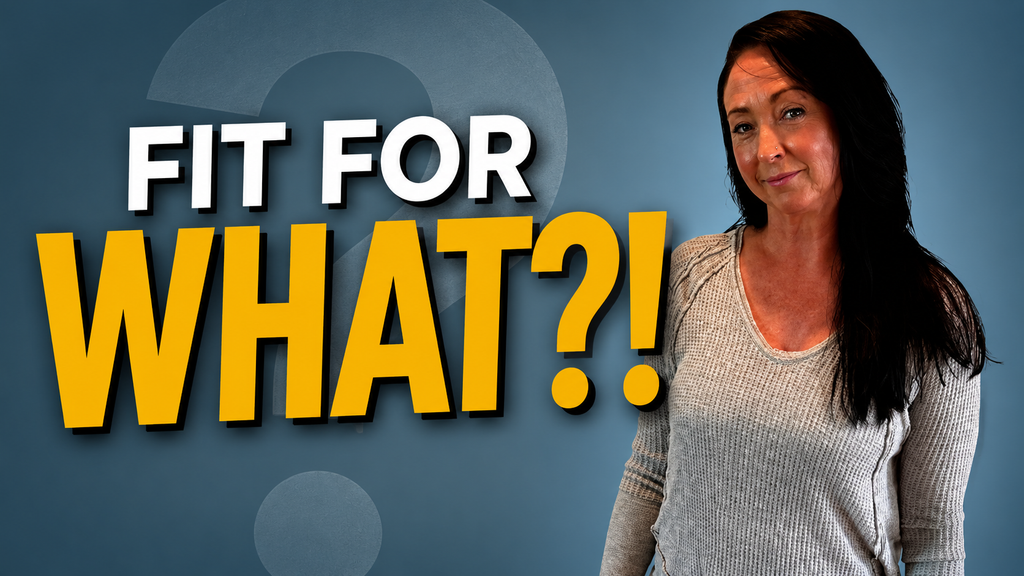
Fit for WHAT?
We talk about “fitness” as though it has one universally accepted definition. You’re fit or you’re not.
But what are we actually measuring?
Can you run a 10K?
Lift a certain amount of weight?
Touch your toes?
Hold a plank for two minutes?
Those things can certainly tell us something about your physical capacity. But you can be really good at any one of them and still struggle with something your actual life asks you to do.
Which makes me wonder if we’ve been asking the wrong question.
Instead of:
What workout should I be doing?
Maybe we should start with:
What do I want my body to be able to do?
Because your workout isn’t the destination.
Your life is.
And your workout should support it.
We Don’t Train to Get Better at Working Out
Last week, I talked about an idea that has become increasingly important to me:
Maintain before you have to reclaim.
Our bodies are incredibly adaptable.
When we regularly ask our bodies to do something, they adapt to meet that demand.
When we stop asking?
Well, our bodies are also incredibly efficient. They’re not particularly interested in maintaining expensive equipment that apparently nobody is using.
Strength.
Mobility.
Balance.
Power.
Endurance.
Coordination.
The ability to squat down and get yourself back up again.
These aren’t abilities we earn once and then own forever.
They’re capacities.
And capacities need to be used.
But here’s the piece I want to add to that conversation:
What exactly are we maintaining them for?
We’re not training so we can become exceptionally good at working out.
We’re training so we’re better prepared for living.
Fitness Is Personal
Imagine two people.
One wants to spend retirement traveling and walking through cities all over the world.
The other wants to spend as much time as possible working in a garden at home.
Do those two people need healthy, capable bodies?
Absolutely.
But their lives may ask different things of those bodies.
Maybe your version of a good life includes hiking.
Maybe it’s playing tennis.
Maybe it’s kayaking.
Maybe you want to be able to pick up your grandchildren.
Maybe you want to carry your own groceries into the house.
Maybe you want to spend an afternoon doing yard work without needing three days to recover.
Maybe you want to walk around Rome all day when you’re 70.
Maybe you simply want to get down on the floor with your dog and know you can get yourself back up again.
Those things aren’t particularly flashy.
Nobody is handing out medals because you carried the 40-pound bag of potting soil from the garage.
But if those things matter to your life, the physical capacities that allow you to do them matter too.
That’s fitness.
Not fitness as performance.
Fitness as capacity.
Your Definition of “Fit” Is Allowed to Change
There’s another piece of this conversation that I think is incredibly important, particularly as we get older.
What you need from your body changes.
At 25, maybe fitness meant running a 10K.
At 35, perhaps it meant having the energy and strength to keep up with your kids.
At 45, maybe you started noticing what years of sitting at a desk were doing to the way your body moved and felt.
At 55, 65 or 75, your priorities may shift again.
Strength matters.
Bone health matters.
Balance matters.
Power matters.
Cardiovascular capacity matters.
Mobility matters.
Adaptability matters.
Not because we’re desperately trying to prevent ourselves from aging.
We’re going to age.
The question is:
What kind of capacity do you want to bring with you?
I don’t want you exercising because you’re afraid of getting older.
I want you moving because you have plans.
Train for Capacity, Not Just Appearance
For decades, we’ve been sold a version of fitness that is overwhelmingly focused on appearance.
Exercise to become smaller.
Leaner.
More toned.
More muscular.
To burn calories.
To change the number on the scale.
To make your body look more like whatever we’re currently being told a “fit body” should look like.
But appearance tells us surprisingly little about what a body is capable of doing.
A body can look fit and still have significant gaps in strength, balance, mobility, endurance or power.
And a body that doesn’t match someone’s cultural image of “fitness” may be strong, capable, resilient and beautifully equipped for the life that person wants to live.
So I’d like to propose a different measuring stick.
Instead of only asking:
What does my body look like?
Start asking:
What can my body do?
Can you carry something heavy?
Can you comfortably reach overhead?
Can you rotate?
Can you balance when the ground isn’t perfectly flat?
Can you move quickly when you need to?
Can you get yourself off the ground?
Can you walk farther than you expected to?
Can your body respond when life doesn’t happen in a perfectly controlled environment?
Those are fitness questions.
And as far as I’m concerned, they’re some of the most important ones.
You Can Exercise Regularly and Still Have Gaps
This is where the conversation gets really interesting.
Because simply exercising doesn’t automatically mean you’re preparing your body for your life.
You could perform the exact same workout five days a week for years.
And you might become extraordinarily good at that workout.
But remember:
Your body adapts specifically to what you ask it to do.
If your workout never challenges your balance, why would you expect your balance to improve?
If you never move quickly, why would your body maintain power?
If you never carry anything, how are you preparing yourself to carry things?
If you always move on perfectly flat surfaces in completely predictable environments, how prepared are you when real life isn’t flat or predictable?
That doesn’t mean your workouts need to become complicated or ridiculous.
You do not need to turn your living room into an obstacle course.
It means we need to start moving with a little more intention.
And that requires knowing what we’re trying to prepare for in the first place.
Start With Your Life
Here’s an exercise I think is far more useful than searching the internet for “the best workout over 50.”
Ask yourself:
What does my life currently ask my body to do?
Then take it one step further.
What do I want my life to ask my body to do five years from now?
Ten years from now?
Twenty years from now?
What would you like to still be saying yes to?
Travel?
Playing with grandchildren?
Hiking?
Gardening?
Golf?
Long walks?
Getting yourself up from the floor?
Living independently?
Trying something you’ve never done before?
Now ask:
What physical capacities support those things?
And finally:
Am I giving my body opportunities to maintain them?
You don’t need to answer every question perfectly.
The point is to start asking them.
That’s Body Literacy
This is exactly why I’m so passionate about body literacy.
I don’t want to hand you another list of exercises you’re “supposed” to do.
I want you to understand enough about your body to ask better questions.
To notice what’s changing.
To understand what those changes might mean.
To recognize where you already have capacity.
To notice where you may be developing gaps.
And then to make thoughtful decisions about what your body needs next.
Not because somebody on the internet handed you a universal list of THE FIVE EXERCISES EVERYONE OVER 50 MUST DO.
Your body isn’t generic.
Your life isn’t generic.
Your goals aren’t generic.
Why should your approach to fitness be?
You Don’t Need to Train for Someone Else’s Life
You don’t have to run because somebody else runs.
You don’t have to become a yogi because I teach yoga.
You don’t have to lift the heaviest weights in the gym.
You don’t have to do burpees.
Frankly, nobody has to do burpees.
There. I said it.
What you need is enough strength, mobility, balance, power, endurance and adaptability to support the things that matter to you.
And then you need to keep using those things.
Because maintaining capacity isn’t about trying to stay exactly as you are forever.
It’s about giving Future You options.
Options to travel.
Options to play.
Options to work.
Options to explore.
Options to help somebody else.
Options to say yes when something interesting comes along.
That’s why we maintain before we have to reclaim.
Not because getting older is something to fear.
But because you have plans.
So the next time someone tells you that you need to “get fit,” ask one very important question:
Fit for WHAT?
And build from there.
Want to Understand Your Body Better?
If you’re reading this and thinking, Okay, but how do I actually get better at understanding what my body needs? — that’s exactly why I created The EveryDay Athlete Mini-Course.
This isn’t another workout program.
It’s an educational course designed to help you better understand how your body works, how it adapts, what it may be asking for, and how to make more informed decisions about the way you move.
Because the goal isn’t for me—or anyone else—to tell you what your body needs forever.
The goal is for you to get better at figuring that out for yourself.
👉 [LEARN MORE ABOUT THE EVERYDAY ATHLETE MINI-COURSE]
🎥 Prefer to watch? [WATCH: FIT FOR WHAT? YOUR WORKOUT SHOULD SUPPORT THE LIFE YOU WANT TO LIVE]
Similar Posts
October 26, 2026
What Happens When Life Stops Challenging Your Body?
The hidden tradeoff of convenience—and why keeping your options open matters as you age. We’ve gotten remarkably good at making life easier. We invented cars so we wouldn’t have to...

October 22, 2026
Yoga Teachers: Stop Confusing Popularity With Skill
Yoga Teachers: Stop Confusing Popularity With Skill Why a full classroom isn’t proof of excellent teaching—and an empty mat isn’t proof of failure. Some of the best yoga teachers I’ve...
October 19, 2026
Why Was This Getting Harder? Maybe Discipline Wasn’t the Problem.
There was a time when I was teaching ten to eighteen yoga and Pilates classes every week. I was active. I exercised regularly. I ate well. I understood the importance...

October 15, 2026
Your Yoga Practice Is Not Your Teaching Qualification
What your personal practice demonstrates—and what it doesn’t tell us about your ability to teach. Yoga teachers, can we talk about something that’s been kinda bugging me for years? Why...
October 12, 2026
Feeling Fine Isn’t the Same as Being Prepared
“I’ll worry about it when I have to.” I’ve heard people say that about their health and physical abilities for years. And I understand it. When nothing hurts and you’re...

October 8, 2026
Yoga Teachers, You Need Better Questions.
What if becoming a more confident yoga teacher isn’t about having more answers, but learning to ask better questions? 🎥 Prefer to watch? Sometimes the most useful thing a yoga...

October 5, 2026
Your Life Might Be Getting Easier—And That’s Not Always Good News
Your life might be getting easier. And that sounds like a good thing, right? In a lot of ways, it absolutely is. We have groceries delivered to our doors. We...
October 1, 2026
Knowing Anatomy Isn’t Enough: What Makes a Better Yoga Teacher?
You can know a whole lot of anatomy and still not know what to do with the person standing in front of you. Imagine you’re teaching a yoga class and...

September 27, 2026
Life Changes the Assignment: Is Your Body Ready?
Why preparing your body for everyday life means building more physical capacity than you currently need. 🎬 Prefer to Watch? Sometimes it’s easier to see an idea come to life...
September 23, 2026
A Good Yoga Teacher Doesn’t Need to Have All the Answers
A Good Yoga Teacher Doesn’t Need to Have All the Answers Has a student ever said something like: “I feel something weird in my knee when I do this.” And...