Your Body Is Always Adapting—For Better or Worse
Heather Otterbine
August 10, 2026
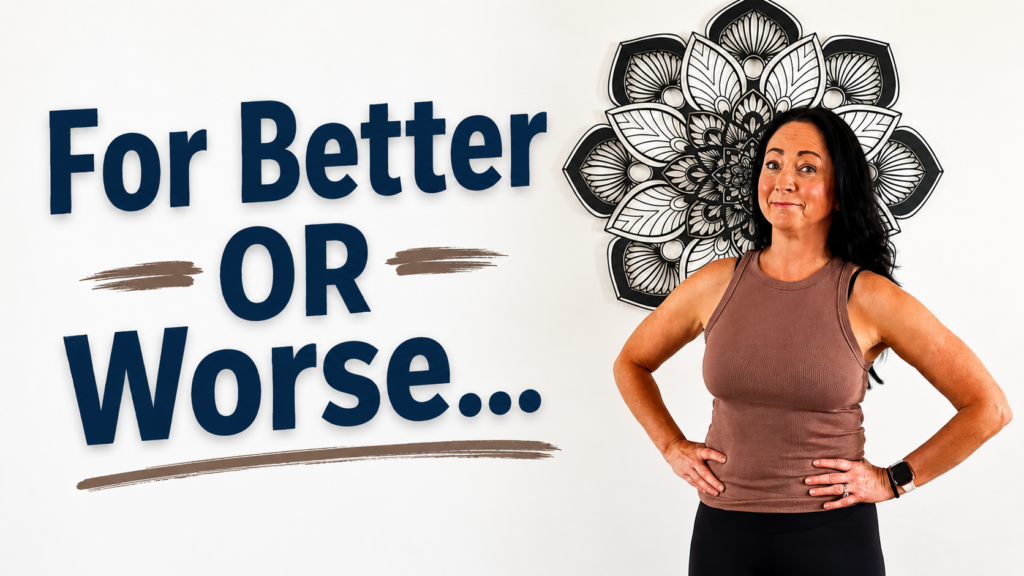
What you repeatedly ask your body to do—and what you stop asking it to do—can shape what stays possible.
I teach movement for a living.
I’ve been teaching yoga for more than 20 years. I teach functional movement and Pilates. I strength train. I’m active.
And last week?
Painting my house kicked my butt!
For several days, I painted walls, doors, and trim. I climbed ladders, reached overhead, squatted, kneeled, scraped windows, moved furniture, and spent hours working in positions that aren’t necessarily part of my usual movement routine.
By the end of it, I was sore in places my regular workouts apparently hadn’t bothered to introduce themselves to in a while.
And I loved it.
Yes, I’m one of those people who enjoys some post-work soreness. Not because I believe a workout has to make you sore to “count”—it absolutely doesn’t—but because in this particular case, that soreness gave me information.
I’d asked my body to do something different.
Different positions. Different durations. Different combinations of movement.
And my body noticed.
That’s the remarkable thing about the human body:
Your body is always adapting.
The question is, what are you asking it to adapt to?
Adaptation Is One of Your Body’s Superpowers
When we think about physical adaptation, we tend to think about the positive side of it.
You lift weights consistently, and your body gets stronger in response to the demand.
You walk regularly, and eventually the same distance doesn’t leave you as winded.
You practice balancing, and over time you become steadier and more confident on your feet.
You regularly move your joints through different ranges of motion, and those movements remain familiar and accessible.
This is an incredibly simplified explanation of a complex physiological process, but the basic principle is pretty straightforward:
Your body adapts to the demands you repeatedly place on it.
That’s one of the reasons exercise works.
But here’s the part we don’t talk about nearly as often:
Your body doesn’t only adapt to what you do. It also adapts to what you stop doing.
Adaptation isn’t inherently good or bad.
Your body isn’t evaluating your lifestyle and deciding whether you’ve been sufficiently virtuous today. 😂
It’s responding to the demands you give it.
And sometimes the demand is…
very little demand at all.
What Happens When We Stop Asking?
If you rarely reach overhead, you may eventually notice that reaching into a high cupboard doesn’t feel as comfortable as it once did.
If you stop carrying heavier things, that suitcase or big bag of groceries may suddenly feel considerably heavier than you remember.
If you stop taking the stairs, a flight or two may begin leaving you more winded.
And if you stop getting down onto the floor, you may eventually discover that getting back up has become a whole lot harder.
None of this means you did something wrong.
Your body adapted.
And please don’t think this conversation only applies to older adults.
It doesn’t.
Your body doesn’t suddenly begin adapting when you qualify for the senior discount.
It’s been adapting your entire life.
Age matters. Our bodies change over time, and pretending otherwise isn’t useful.
But age isn’t the only input.
How you use your body matters, too.
Which is why I want you thinking about this long before you’re worried about “getting old.”
Maintain before you have to reclaim.
Don’t wait until something becomes difficult to decide it was worth maintaining.
You’re Fit…But Fit for What?
We tend to use the word fit as though it’s a single characteristic.
“She is really fit.”
Okay.
Fit for what?
Running?
Lifting?
Hiking?
Getting off the floor?
Carrying two heavy grocery bags from the car because making a second trip is apparently an admission of defeat? 😂
Painting French doors for an unreasonable number of consecutive hours?
My week of painting was a fantastic reminder that fitness is specific.
My regular movement practice hadn’t failed me. Quite the opposite—it gave me the strength, mobility, balance, and endurance to spend hours doing physically demanding work.
But painting created demands that were different from the ones I regularly give my body.
A runner can have tremendous cardiovascular endurance and still find carrying something heavy upstairs challenging.
Someone who strength trains regularly may discover that hours of hiking over uneven terrain demand something entirely different.
Someone who practices yoga may have plenty of flexibility but encounter an activity that requires strength, power, or endurance their usual practice doesn’t emphasize.
We’re all adapting to what we repeatedly do.
So perhaps instead of asking:
“Am I fit?”
there’s a better question:
“Am I fit for the life I want to live?”
The Quiet Loss of Capacity
Some changes in our physical capacity are obvious.
Others happen so gradually that we barely notice them.
Imagine that getting onto the floor starts becoming a little more difficult.
Maybe your knees aren’t thrilled about it. Maybe getting back up takes more effort than it used to.
So you stop getting onto the floor as often.
That’s completely understandable.
But now you’re also giving your body fewer opportunities to practice the mobility, strength, balance, and coordination required to get down and back up.
Eventually, it becomes harder.
So you do it even less.
And now there’s a loop:
It gets harder → you do it less → your body gets fewer opportunities to maintain the capacity → it gets harder → you do it even less.
The same thing can happen with stairs, reaching, carrying, walking longer distances, balancing, and countless other physical abilities.
Something becomes difficult, so we remove the demand.
Then our bodies adapt to the new demand.
This isn’t a reason to judge yourself.
It’s a reason to get curious.
Ask:
What am I no longer asking my body to do?
You may find some surprisingly useful information in the answer.
Your Body Is Responding to the Life You’re Giving It
Your body isn’t betraying you when it adapts.
It’s doing its job.
If your life requires you to sit for much of the day, your body becomes very familiar with sitting.
And no, sitting isn’t evil.
I like sitting. 😂
You don’t need to manufacture hardship all day or churn your own butter in the name of shoulder strength.
But modern life has become exceptionally good at removing physical demands.
We don’t necessarily have to squat.
Carry.
Climb.
Reach.
Walk very far.
Get onto the ground.
Or lift much of anything.
And if our everyday lives aren’t providing those demands, we may need to intentionally put some of them back.
Because when you regularly walk, lift, carry, push, pull, reach, rotate, balance, squat, and get yourself off the floor, you’re reminding your body:
Hey. We still use these things.
What Do You Want to Keep?
This is why I don’t particularly like talking about healthy aging from a place of fear.
I don’t want you moving your body because you’re terrified of everything you’re supposedly destined to lose.
I’d rather ask:
What do you want to keep?
Do you want to travel and spend the day exploring a new city?
Garden?
Hike?
Play with your grandchildren?
Carry your own groceries?
Put your suitcase into the overhead compartment?
Sit comfortably on the floor?
Get back up?
Keep doing your own damn home renovations at 75?
Apparently, I’ve chosen that last one. 😂
Those aren’t abstract fitness goals.
That’s your life.
And those are the things worth training for.
The Good News: Adaptability Works Both Ways
This is the part I really want you to remember.
The same adaptability that allows your body to become accustomed to doing less is what allows it to respond when you begin asking it to do more.
That doesn’t mean going from never sitting on the floor to doing 50 floor transfers tomorrow.
Please don’t.
It means giving your body appropriate, progressive opportunities to practice the capacities you care about.
If you want to continue getting off the floor, practice getting off the floor in a way that’s appropriate for you.
If you want to carry things, carry.
If balance matters to you, challenge your balance.
If you want to comfortably reach overhead, continue exploring that range.
If you want stairs to remain manageable, keep giving your body opportunities to climb.
Your body doesn’t need perfection.
It needs input.
And ideally, some variety in that input.
Your Sport Is Your Life
This is exactly what I mean when I talk about becoming an EveryDay Athlete.
I’m not trying to turn everyone into a competitive athlete.
Your sport is your life.
And your life requires movement.
Walking. Carrying. Reaching. Balancing. Getting off the floor. Changing direction. Moving through different ranges of motion. Responding to the unexpected.
Your body is constantly adapting to how often—or how rarely—you ask it to do those things.
So rather than endlessly searching for the “best workout,” try asking:
What do I want my body to remain capable of doing?
Then look at your life.
Are you giving your body opportunities to practice those abilities?
Because exercise isn’t only about calories.
It isn’t punishment for what you ate.
And it isn’t something you do because your body needs to be fixed.
Exercise is practice for your life.
When you start looking at movement that way, the goal changes.
You’re no longer chasing somebody else’s definition of fitness.
You’re building and protecting your capacity to live your life.
One Question to Ask Yourself Today
Think about one thing you used to do regularly that you don’t do very often anymore.
Not because you decided you don’t care about it.
But because somewhere along the way…
it got harder.
Maybe it’s getting onto the floor.
Taking the stairs.
Walking longer distances.
Getting out of a chair without using your hands.
Carrying something heavy.
Reaching overhead.
Balancing on one foot.
Don’t judge what you find.
Just notice it.
Then ask yourself:
“Have I stopped doing this because I’ve lost some capacity—or have I lost some capacity because I stopped doing it?”
The answer might be:
A little bit of both.
And that’s okay.
Because adaptability works both ways.
You can begin giving your body a reason to pay attention to that ability again—appropriately, gradually, and consistently.
Become an EveryDay Athlete
If this way of thinking about movement feels different from the usual “here’s another workout you should be doing” conversation, that’s intentional.
Inside The EveryDay Athlete Mini-Course, we explore the movement abilities your everyday life depends on—why they matter, where they show up, and how understanding your own body can help you make more intentional choices about the way you move.
Because I don’t want to simply tell you what to do.
I want you to understand why it matters to your life.
LEARN MORE ABOUT THE EVERYDAY ATHLETE MINI-COURSE
And whether you join me there or not, remember:
Your body is always adapting.
The question isn’t whether adaptation is happening.
What are you asking your body to adapt to—and does that support the life you want to keep living?
Similar Posts
October 26, 2026
What Happens When Life Stops Challenging Your Body?
The hidden tradeoff of convenience—and why keeping your options open matters as you age. We’ve gotten remarkably good at making life easier. We invented cars so we wouldn’t have to...

October 22, 2026
Yoga Teachers: Stop Confusing Popularity With Skill
Yoga Teachers: Stop Confusing Popularity With Skill Why a full classroom isn’t proof of excellent teaching—and an empty mat isn’t proof of failure. Some of the best yoga teachers I’ve...
October 19, 2026
Why Was This Getting Harder? Maybe Discipline Wasn’t the Problem.
There was a time when I was teaching ten to eighteen yoga and Pilates classes every week. I was active. I exercised regularly. I ate well. I understood the importance...

October 15, 2026
Your Yoga Practice Is Not Your Teaching Qualification
What your personal practice demonstrates—and what it doesn’t tell us about your ability to teach. Yoga teachers, can we talk about something that’s been kinda bugging me for years? Why...
October 12, 2026
Feeling Fine Isn’t the Same as Being Prepared
“I’ll worry about it when I have to.” I’ve heard people say that about their health and physical abilities for years. And I understand it. When nothing hurts and you’re...

October 8, 2026
Yoga Teachers, You Need Better Questions.
What if becoming a more confident yoga teacher isn’t about having more answers, but learning to ask better questions? 🎥 Prefer to watch? Sometimes the most useful thing a yoga...

October 5, 2026
Your Life Might Be Getting Easier—And That’s Not Always Good News
Your life might be getting easier. And that sounds like a good thing, right? In a lot of ways, it absolutely is. We have groceries delivered to our doors. We...
October 1, 2026
Knowing Anatomy Isn’t Enough: What Makes a Better Yoga Teacher?
You can know a whole lot of anatomy and still not know what to do with the person standing in front of you. Imagine you’re teaching a yoga class and...

September 27, 2026
Life Changes the Assignment: Is Your Body Ready?
Why preparing your body for everyday life means building more physical capacity than you currently need. 🎬 Prefer to Watch? Sometimes it’s easier to see an idea come to life...
September 23, 2026
A Good Yoga Teacher Doesn’t Need to Have All the Answers
A Good Yoga Teacher Doesn’t Need to Have All the Answers Has a student ever said something like: “I feel something weird in my knee when I do this.” And...