
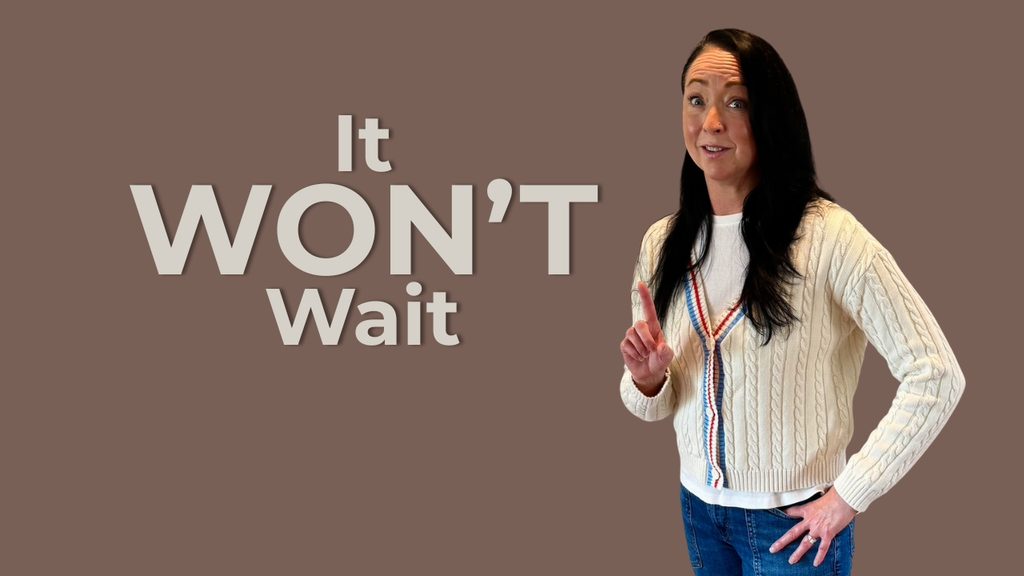
I’m going to say something you might not want to hear.
Time is not going to stop for you.
It’s not going to wait until work settles down.
It’s not going to wait until the kids need you less.
It’s not going to wait until you finally have more time, more energy, or a less complicated schedule.
It’s just going to keep moving.
I don’t say that to lecture you or scare you.
I say it because we have a tendency to treat our physical capacity like something we can deal with later.
🎥 Prefer to watch?
Watch Time Is Not Going to Stop for You on YouTube.
I’ll work on my strength when I have more time.
I’ll worry about my balance if it becomes a problem.
I’ll start taking better care of myself when things calm down.
Except sometimes later arrives and we realize that something we used to do without thinking now requires a little more effort.
Maybe getting up from the floor feels different.
Maybe carrying something heavy takes more out of you.
Maybe you notice yourself reaching for the railing on stairs you used to climb without thinking twice.
That doesn’t mean something has gone terribly wrong.
Bodies change. Aging happens.
But it may be worth getting curious about what you want your body to keep letting you do—and what those things actually require.
The Life You Want Has Physical Requirements
We often talk about exercise in terms of workouts.
How many times did you exercise this week?
Did you get your steps?
Did you do your strength training?
Those things can certainly matter.
But I think there’s a much more interesting question:
What do you want your body to keep letting you do?
Want to keep traveling?
Think about what traveling actually asks of your body.
You might need to lift a suitcase into the trunk of a car.
Walk through an airport carrying a bag.
Climb stairs.
Navigate cobblestones or uneven sidewalks.
Get yourself in and out of unfamiliar beds, chairs, trains, boats, taxis, or airplanes.
And then wake up the next morning with enough capacity to go do it all again.
That vacation has a physical job description.
So does gardening.
So does hiking.
So does playing with your grandkids.
So does living independently.
So does getting down on the floor with the dog and getting yourself back up.
The activities may be completely different.
But every one of them asks something of your body.
Capacity Gives You Options
This is why I talk so much about physical capacity.
Strength is capacity.
Balance is capacity.
Mobility is capacity.
Power, coordination, endurance and the ability to recover are capacities.
And when we have enough of the capacities an activity requires, we tend to have more options for how we participate in it.
That doesn’t mean we can control everything that happens to our bodies.
We can’t.
Bodies are affected by genetics, injuries, illnesses, hormones, medications, circumstances, access to resources and plenty of things that aren’t completely within our control.
Healthy aging isn’t a promise that if you do everything “right,” nothing will ever change.
It will.
The question is what we can influence.
And one of the things we can often influence is whether we continue giving our bodies opportunities to use and maintain the capacities that matter to us.
Maintain Before You Have to Reclaim
This is one of the ideas at the heart of everything I teach:
Maintain before you have to reclaim.
Because maintaining a capacity you already have is often very different from trying to rebuild it after you’ve stopped using it.
Think about balance.
If the only time we decide balance matters is after it has become noticeably difficult, we’re starting from a very different place than if we’ve been challenging it all along.
The same is true of strength.
Getting up from the floor requires strength.
Carrying groceries requires strength.
Picking up a grandchild requires strength.
Hauling your suitcase up a flight of stairs requires strength.
You don’t have to wait until one of those things becomes difficult before strength becomes relevant.
It was relevant the entire time.
That’s the shift I want people to make.
Not:
I need to exercise because I’m getting older.
But:
I want to maintain the physical resources that help me keep participating in my life.
Those are two very different relationships with movement.
You Don’t Need to Train for Someone Else’s Life
And this is where things get really interesting.
Your physical priorities don’t have to look like mine.
If your idea of an amazing life is spending three weeks hiking through national parks, your body has one job description.
If you want to travel to Italy and spend your days walking through old cities, yours has another.
Maybe you want to garden for hours.
Golf.
Kayak.
Dance at your granddaughter’s wedding.
Keep working on your own house.
Walk your dog every morning.
Get on the floor and build Lego castles with a five-year-old.
There isn’t one universal list of physical capacities everyone needs in exactly the same amounts.
Your life helps determine what matters.
And THAT is where exercise gets a whole lot more interesting.
Instead of asking:
“What exercises am I supposed to be doing at my age?”
We can start asking:
“What does the life I want ask my body to be able to do?”
Now we have something useful to work with.
Time Is Going to Keep Moving
None of us gets to negotiate with that part.
A year from now will arrive.
Five years from now will arrive.
Ten years from now will arrive if we’re fortunate enough to get them.
I’m not interested in spending those years trying to make my body look like it did when I was 25.
I’m interested in helping my body remain capable of participating in the life I want to live.
That’s why I train.
That’s why I teach what I teach.
And that’s why I think the conversation around healthy aging needs to become much bigger than simply telling people they should exercise.
Because exercise isn’t the prize.
Your life is the point.
What Do You Want Your Body to Keep Letting You Do?
This is exactly why I created The EveryDay Athlete Decoder.
You tell it something you want your body to keep letting you do—travel, garden, hike, play with your grandkids, whatever matters to you—and it helps you uncover the physical demands and capacities hiding inside that activity.
We’re not grading your body.
We’re getting curious about it.
Tell the Decoder what you want your body to keep LETTING you do and discover its physical job description.
👉 Try The EveryDay Athlete Decoder — it’s free.
DECODER LINK
And if you want to go deeper into understanding physical capacity and how it connects to everyday life, you can continue with The EveryDay Athlete Mini-Course.
👉 Explore The EveryDay Athlete Mini-Course.
MINI-COURSE LINK
Similar Posts
October 26, 2026
What Happens When Life Stops Challenging Your Body?
The hidden tradeoff of convenience—and why keeping your options open matters as you age. We’ve gotten remarkably good at making life easier. We invented cars so we wouldn’t have to...

October 22, 2026
Yoga Teachers: Stop Confusing Popularity With Skill
Yoga Teachers: Stop Confusing Popularity With Skill Why a full classroom isn’t proof of excellent teaching—and an empty mat isn’t proof of failure. Some of the best yoga teachers I’ve...
October 19, 2026
Why Was This Getting Harder? Maybe Discipline Wasn’t the Problem.
There was a time when I was teaching ten to eighteen yoga and Pilates classes every week. I was active. I exercised regularly. I ate well. I understood the importance...

October 15, 2026
Your Yoga Practice Is Not Your Teaching Qualification
What your personal practice demonstrates—and what it doesn’t tell us about your ability to teach. Yoga teachers, can we talk about something that’s been kinda bugging me for years? Why...

October 12, 2026
Feeling Fine Isn’t the Same as Being Prepared
“I’ll worry about it when I have to.” I’ve heard people say that about their health and physical abilities for years. And I understand it. When nothing hurts and you’re...

October 8, 2026
Yoga Teachers, You Need Better Questions.
What if becoming a more confident yoga teacher isn’t about having more answers, but learning to ask better questions? 🎥 Prefer to watch? Sometimes the most useful thing a yoga...

October 5, 2026
Your Life Might Be Getting Easier—And That’s Not Always Good News
Your life might be getting easier. And that sounds like a good thing, right? In a lot of ways, it absolutely is. We have groceries delivered to our doors. We...

October 1, 2026
Knowing Anatomy Isn’t Enough: What Makes a Better Yoga Teacher?
You can know a whole lot of anatomy and still not know what to do with the person standing in front of you. Imagine you’re teaching a yoga class and...

September 27, 2026
Life Changes the Assignment: Is Your Body Ready?
Why preparing your body for everyday life means building more physical capacity than you currently need. 🎬 Prefer to Watch? Sometimes it’s easier to see an idea come to life...
September 23, 2026
A Good Yoga Teacher Doesn’t Need to Have All the Answers
A Good Yoga Teacher Doesn’t Need to Have All the Answers Has a student ever said something like: “I feel something weird in my knee when I do this.” And...