
A Modification Isn’t Automatically an Easier Version of a Yoga Pose
Heather Otterbine
September 17, 2026
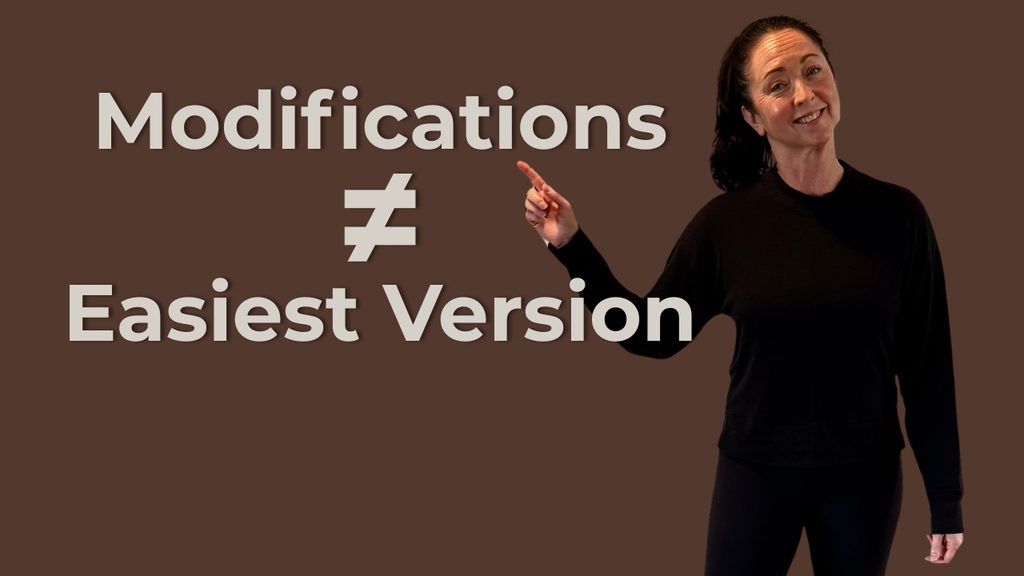
A modification isn’t automatically an easier version of a yoga pose.
It’s a change in demand.
And once you start thinking about modifications that way, it can completely change how you teach them.
Because I think a lot of us learned modifications as a hierarchy.
There’s the “full expression” of the pose.
Can’t do that? Use a block.
Still can’t do it? Try this.
Need more help? Here’s the chair.
And before we know it, we’ve accidentally created a system where the unsupported version of the pose sits at the top—and every modification represents another step down.
Which is how the chair somehow became the kiddie table of yoga.
It’s not.
It’s a tool.
And what matters isn’t whether you used a chair, a block, a wall, or changed the movement entirely.
What matters is:
What demand did you change—and why?
A Modification Changes Something
Let’s say I’m teaching a standing balance exercise and my goal is to challenge hip strength.
I could have someone perform the movement without support.
Now they’re dealing with several demands at once: producing force at the hip, controlling their position, and maintaining balance.
But what if balance becomes the thing that limits how much they can actually challenge the hip?
I might give them a chair.
Did I make the exercise “easier”?
I reduced the balance demand, yes.
But that change may allow them to work harder at the hip—which was the capacity I actually wanted to challenge in the first place.
That’s a very different way of thinking about modification.
I didn’t give them the lesser version of the exercise.
I changed a demand so the movement better served the person and the purpose.
Ask a Better Question
This is why I don’t think yoga teachers need bigger and bigger collections of modifications to memorize.
We need to get better at understanding what we’re changing.
Instead of automatically asking:
“What’s the easier version?”
Try asking:
“What’s actually creating the challenge here?”
And then:
“What happens if I change that?”
Maybe you reduce the balance demand.
Maybe you increase stability.
Maybe you change the range of motion.
Maybe you change the load.
Maybe you change the relationship to gravity.
The important part isn’t simply that you modified something.
It’s that you understand why you’re changing it.
And Then You Have to Watch
There’s another piece of this that matters:
You don’t actually know whether your awesom modification was brilliant until you see how the person responds.
Because teaching isn’t:
Choose modification → congratulations, problem solved.
It’s a process.
Observe.
Change something intentionally.
Reassess.
Did the change accomplish what you thought it would?
Did something unexpected happen?
Did you reduce one demand only to discover that something else was actually driving the challenge?
That’s information.
And that’s where teaching gets interesting.
Better Teaching Isn’t About Having More Answers
I think teachers sometimes assume that becoming more skilled means accumulating more answers.
More cues.
More modifications.
More exercises.
More things to pull out of the giant imaginary teacher toolbox.
Those things can certainly be useful.
But at some point, what matters more is your ability to make decisions with what you know.
To observe what’s happening.
To understand the demands of what you’re asking someone to do.
To change something intentionally.
And then to pay attention to what happens next.
Not bigger collections of modifications. Better decision-making.
That’s a skill you can practice.
And the more you practice it, the less teaching becomes about searching your brain for the “correct” modification—and the more it becomes about responding thoughtfully to the person standing in front of you.
Prepare for the Demands, Not the Shape
A yoga pose is one possible way to organize movement.
It isn’t the goal by default.
So before deciding how someone should perform a pose—or which version they should be working toward—ask what you’re actually trying to accomplish.
What capacity are you challenging?
What demands are involved?
Which of those demands matter for your purpose?
And which ones might you change?
Because a modification doesn’t automatically mean someone has taken a step down.
Sometimes it simply means the teacher made a better decision.
The pose isn’t the prize.
The person is the point.
Want to Get Better at Making Those Decisions?
That’s exactly why I created The Yoga Teacher Companion.
She’s designed to help yoga teachers think through real teaching questions around cueing, sequencing, modifications, and those moments when something happens in class and you’re left wondering:
Okay…what was going on there?
Because I don’t think what most teachers need is another giant list of modifications to memorize.
I think they need opportunities to practice making better teaching decisions.
If you want to spend less time second-guessing your teaching decisions and get better at thinking through what you’re seeing in the room, come meet The Yoga Teacher Companion. It’s like have education and mentorship right in your pocket!
MEET THE YOGA TEACHER COMPANION →
Prefer to Watch On YouTube?
A Modification Is Not Necessarily The Easiest Version of A Pose
Similar Posts

November 16, 2026
The Hidden Cost of Making Life Easier
What a dust bunny eviction taught me about healthy aging, physical capacity, and the freedom to make our own choices. This weekend, I found myself lying on my belly underneath...

November 11, 2026
The Students You’re Overlooking: Why Yoga Teachers Need to Pay Attention to an Aging Population
What if one of the greatest opportunities for yoga teachers isn’t a new style of yoga, a trendy class format, or another certification? What if it’s an entire population of...
November 8, 2026
Doing Less or Doing Different? Why Healthy Aging Requires More Than Giving Things Up
Sometimes maintaining the life you love means changing how you do things—not abandoning them. I absolutely love running on my treadmill. But I don’t run anymore. And that wasn’t an...

November 5, 2026
Yoga Class Sequencing: What Are You Actually Preparing Your Students For?
Thoughtful yoga class sequencing isn’t just about choosing poses that flow together. It’s about understanding what you’re asking students to practice—and why. You plan a yoga class. The transitions make...
November 2, 2026
Why “I Feel Fine” Is Lying to You After 50
“I feel fine.” It’s a reassuring thought—and a convincing reason to put something off. Nothing hurts. You can do what you need to do. Whatever you’re doing seems to be...

October 29, 2026
Build It and They Will Come Is NOT a Marketing Strategy
What more than 20 years of running a yoga business taught me about hard work, marketing, and professional integrity. I spent more than twenty years running a yoga business before...

October 26, 2026
What Happens When Life Stops Challenging Your Body?
The hidden tradeoff of convenience—and why keeping your options open matters as you age. We’ve gotten remarkably good at making life easier. We invented cars so we wouldn’t have to...

October 22, 2026
Yoga Teachers: Stop Confusing Popularity With Skill
Yoga Teachers: Stop Confusing Popularity With Skill Why a full classroom isn’t proof of excellent teaching—and an empty mat isn’t proof of failure. Some of the best yoga teachers I’ve...

October 19, 2026
Why Was This Getting Harder? Maybe Discipline Wasn’t the Problem.
There was a time when I was teaching ten to eighteen yoga and Pilates classes every week. I was active. I exercised regularly. I ate well. I understood the importance...

October 15, 2026
Your Yoga Practice Is Not Your Teaching Qualification
What your personal practice demonstrates—and what it doesn’t tell us about your ability to teach. Yoga teachers, can we talk about something that’s been kinda bugging me for years? Why...