
Working With Older Adults Doesn’t Mean Removing the Challenge
Heather Otterbine
September 10, 2026
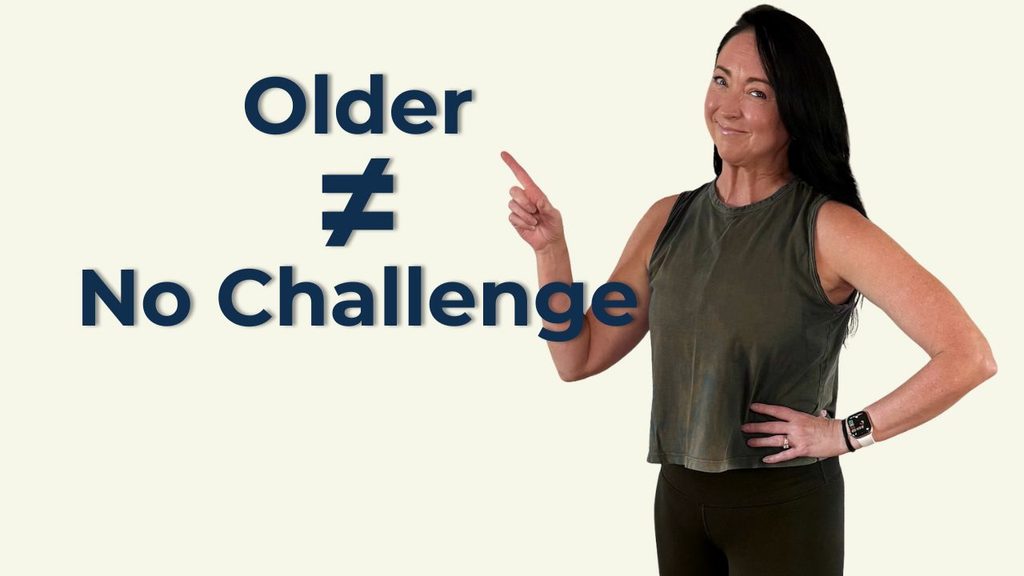
If you teach older adults, there’s an important distinction worth making:
Are you adapting movement to the person in front of you—or are you making assumptions about what they can do based on their age?
Those are not the same thing.
There’s a tendency in yoga and fitness spaces to approach older adults by immediately making movement easier.
Reduce the load.
Simplify the balance work.
Take out complicated transitions.
Avoid getting down onto the floor.
Decrease the range of motion.
Sometimes those choices are absolutely appropriate.
But they should be appropriate because of the person, not simply because someone happens to be 65, 70, or 75 years old.
I’ve worked extensively with older adults for years, and some of my students in their seventies are incredibly strong and capable movers. They squat. They lunge. They balance. They rotate. They move through complex patterns. They get themselves down onto the floor and back up again.
And I continue to challenge them.
Not because I’m ignoring their age.
Because I’m paying attention to their capacity.
Appropriate Doesn’t Mean Easy
One of the biggest mistakes we can make when preparing classes for older adults is confusing appropriate with easy.
Appropriate challenge means the demand matches the person.
Imagine we’re working on balance.
One student may need the support of a chair.
Another may be ready to balance without external support.
Another may need movement added to the balance challenge.
Another may benefit from load.
Another may be ready for more coordination or unpredictability.
None of those options is inherently better than another.
The question is whether the demand is appropriate for the person doing it.
Chronological age doesn’t answer that question for us.
Two 70-year-olds can walk into the same class with completely different movement histories, strengths, limitations and needs.
That’s why good teaching requires us to observe the person or people rather than plan classes based on what year they were born.
Progression Isn’t Just Making Something Harder
This is where intentional progression becomes so important.
When teachers hear progression, it’s easy to imagine a ladder:
Easy version → harder version → hardest version.
But that’s a very limited way of thinking about progression.
We can change all kinds of variables within a movement:
- Load
- Range of motion
- External support
- Tempo
- Coordination
- Complexity
- Stability
- How a movement is integrated into a larger pattern
Progression means understanding what demand we’re trying to train and knowing how to manage that demand appropriately.
It does not mean everyone needs to arrive at the same destination.
And sometimes, we don’t need to progress something at all.
Maintain Before You Have to Reclaim
I say this all the time:
Maintain before you have to reclaim.
If someone can comfortably get down onto the floor and stand back up again, why would we stop asking them to use that capacity simply because they’ve reached a particular age?
If they can balance, we want them to keep balancing.
If they’re strong, we want them to keep using their strength.
If they can coordinate complex movements, we want to continue giving them opportunities to practice that capacity.
Maintaining an ability someone already has can be an incredibly worthwhile practice and training goal.
Because capacity needs a reason to stick around.
And this is where I think our approach to aging sometimes gets backward.
We can become so focused on protecting older adults that we begin removing demands before the person has demonstrated that the demand needs to be removed.
That’s not the same thing as thoughtful modification.
Sometimes the better question isn’t:
How do I remove this demand?
It’s:
How do I prepare this person for this demand?
Your student’s age gives you information. It doesn’t tell you how to teach them.
Age matters.
So do health history, injury history, recovery, movement experience, confidence, goals and current capacity.
But age alone tells us remarkably little about what someone standing in front of us can actually do.
One 70-year-old may have been physically active for decades.
Another may be returning to movement after years of inactivity.
One may have excellent balance and limited shoulder mobility.
Another may be tremendously strong but find coordination challenging.
Another may need considerable external support today and much less six months from now.
Good teaching requires curiosity.
What can this person currently do?
Where does the challenge begin?
What happens if I change one variable?
Can I increase the demand while maintaining the quality of movement I’m looking for that indicates is safe for the students in front of me?
If something isn’t working, can I modify the demand without removing the challenge altogether?
That’s teaching.
Not deciding what someone should or shouldn’t do because of the number attached to their birthday.
Leave Room for People to Surprise You
There’s another reason this matters.
When we make assumptions about older students, we can unintentionally stop giving them opportunities to discover what they’re capable of.
Safety matters.
Health conditions matter.
Individual history matters.
Recovery matters.
Appropriate modifications matter.
And challenge matters.
Because we’re not simply helping someone safely complete today’s yoga or movement class.
We’re helping them maintain capacities they may want available in their lives.
Getting up from the ground.
Climbing stairs.
Carrying something heavy.
Reacting when they lose their balance.
Working in the garden.
Traveling.
Playing with grandchildren.
Doing the things that make life feel like their life.
Those things require capacity.
And capacity has to be used.
So the next time you’re putting a class together for older adults, instead of beginning with:
How do I make this easier?
Try beginning with:
What do I know about this person or group of people, and what is the appropriate challenge for them right now?
Observe.
Adjust.
Progress when appropriate.
Maintain when appropriate.
And give people enough opportunity to continue being capable.
Good class planning for older adults isn’t about removing challenge. It’s about choosing the right challenge—and progressing it with intention.
Prefer to Watch OnYouTube? Older Does Not Mean Don’t Challenge
Want More Conversations Like This?
Teaching yoga can be a surprisingly lonely job.
You have questions about a student. You’re thinking through a progression. Something worked beautifully in class—or you walk out wondering what on earth just happened. 😂
And often, there isn’t another teacher around to talk it through with.
That’s why I created The Yoga Teacher Collective.
It’s a place for real conversations about teaching, with a monthly live online gathering, an ongoing community for your questions, and practical teaching resources you can actually use.
When you join, you’ll also immediately receive The Progression Builder, our first teaching resource, designed to help you think through the demands you’re training and create intentional progressions for the students actually standing in front of you.
The Yoga Teacher Collective is $19/month, cancel anytime, and enrollment is open now.
Come join us. I’d love to have you in the room.
Similar Posts

September 14, 2026
Your Body Needs a Retirement Plan
We spend decades planning for the life we hope to have later. We save money. We contribute to retirement accounts. We make choices today because we believe Future Us will...
September 10, 2026
Working With Older Adults Doesn’t Mean Removing the Challenge
If you teach older adults, there’s an important distinction worth making: Are you adapting movement to the person in front of you—or are you making assumptions about what they can...

September 7, 2026
September Is the New January
There’s something about September that has always felt like a fresh start. Maybe it’s years of back-to-school conditioning. The weather begins to change. Summer schedules wind down. Vacations are mostly...

August 30, 2026
What Are You Actually Training For? | Fitness for Real Life After 50
We tend to talk about fitness as though the workout itself is the accomplishment. How much weight did you lift? How many reps did you do? How long did you...

August 27, 2026
Your Student’s Body Is Not a Problem to Solve
There’s a moment that happens in yoga classes all the time. A teacher looks across the room and notices something. One foot turns out. One hip appears higher than the...

August 24, 2026
Fit for WHAT? Your Workout Should Support the Life You Want to Live
Everybody wants to get fit. Okay. Fit for WHAT? We talk about “fitness” as though it has one universally accepted definition. You’re fit or you’re not. But what are we...

August 17, 2026
Maintain Before You Have to Reclaim
There are things your body does every single day that you probably don’t think much about. You get up from a chair. Carry groceries into the house. Reach into the...

August 10, 2026
Your Body Is Always Adapting—For Better or Worse
What you repeatedly ask your body to do—and what you stop asking it to do—can shape what stays possible. I teach movement for a living. I’ve been teaching yoga for...

August 3, 2026
Why Stretching Isn’t Fixing Your Tight Muscles
Have you ever stretched the same muscle day after day…only to have it feel tight again a few hours later? Maybe it’s your hamstrings. Your shoulders. Your neck. Or that...
July 26, 2026
Why Stretching Isn’t Always the Answer
Have you ever noticed that the same part of your body always feels tight? Maybe it’s your neck after a long day at the computer. Your shoulders while you’re driving....