
Your Student’s Body Is Not a Problem to Solve
Heather Otterbine
August 27, 2026
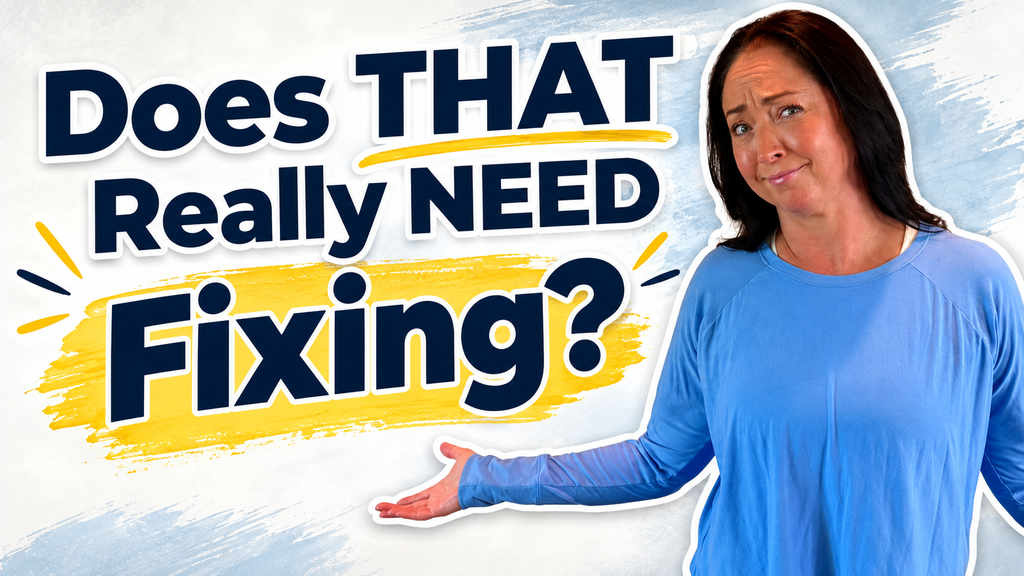
There’s a moment that happens in yoga classes all the time.
A teacher looks across the room and notices something.
One foot turns out.
One hip appears higher than the other.
A knee doesn’t point in the direction we were taught it should.
A pelvis isn’t perfectly level.
One side of a pose looks noticeably different from the other.
And almost immediately, Teacher Brain kicks in:
I need to fix that.
So we cue.
“Turn your foot forward.”
“Square your hips.”
“Level your pelvis.”
“Pull that shoulder back.”
Sometimes those cues are useful.
But sometimes we’re trying to correct something before we actually understand what we’re looking at.
And that distinction matters.
Because your student’s body is not a problem for you to solve.
Yoga Teachers Are Very Good at Finding What’s “Wrong”
Most yoga teachers were trained using some version of an idealized pose.
Here is Mountain Pose.
Here is Warrior II.
Here is Triangle.
Here is what the feet should do.
Here is where the knees should point.
Here is how the pelvis should be positioned.
Here is where the shoulders belong.
Learning those reference points can be useful. They give us a place to begin understanding movement and teaching it to someone else.
But somewhere along the way, reference points can quietly become rules.
And once we have a rule in our heads, we become remarkably good at spotting anything that doesn’t conform to it.
The student’s foot turns out.
The rule says feet should be parallel.
Therefore, the foot needs correcting.
Except we’ve skipped an incredibly important question:
Why is the foot turning out?
Observation and Interpretation Are Not the Same Thing
This is one of the most important distinctions we can learn to make as movement teachers.
An observation might be:
Her right foot turns outward when she stands.
That’s simply information.
But within seconds, we can turn that observation into a story.
Her hip must be externally rotated.
She must have a mobility restriction.
She has an imbalance.
Her alignment is wrong.
She needs to strengthen something.
She needs to stretch something.
Now we’re no longer observing.
We’re interpreting.
And our interpretation may be correct.
Or it may not be.
Maybe the foot position is habitual.
Maybe it’s a movement strategy.
Maybe she feels more stable there.
Maybe moving the foot changes discomfort somewhere else.
Maybe there’s a structural reason that position works better for her.
Or maybe that’s simply how this particular human body is built.
You cannot know all of that by standing at the front of the room and looking at someone’s foot.
That doesn’t mean we stop observing.
It means we become more thoughtful about what we do with our observations.
There Is No Standard Human Body
Human anatomy is wonderfully variable.
Our skeletons are not identical.
The shape and orientation of our joints vary.
The proportions of our limbs vary.
Our spinal curves vary.
Our rib cages vary.
Our pelvises vary.
The orientation of the hip socket varies.
The shape and orientation of the femur vary.
And those differences can influence what movement looks like from the outside.
Two healthy people can perform the same movement and create noticeably different shapes.
Neither person necessarily needs to be corrected.
This is where rigid alignment rules can become problematic.
When we treat alignment as anatomical law, we risk teaching students that anything outside the prescribed shape represents dysfunction.
But alignment and anatomy are not the same thing.
Alignment Is a Tool, Not a Universal Law
I’m not suggesting that alignment doesn’t matter.
And I’m definitely not suggesting that anything goes and we should simply fling ourselves into yoga poses however we please.
Alignment can be an incredibly useful teaching tool.
Changing someone’s position can alter load.
It can change muscular demand.
It can provide a different movement strategy.
It can increase or decrease stability.
It can make a movement more accessible.
It can change how something feels.
Those are excellent reasons to experiment with alignment.
But notice the word:
Experiment.
Instead of:
“Your foot needs to be parallel.”
What happens if we ask:
“What changes if you bring your foot slightly more forward?”
Instead of:
“Square your hips.”
We might explore:
“Does changing the position of your pelvis affect what you feel here?”
Now alignment becomes something we investigate rather than something we impose.
That is a very different relationship with the person standing in front of us.
Different Does Not Automatically Mean Dysfunctional
Asymmetry is not automatically dysfunctional.
Limited range of motion is not automatically dysfunctional.
Greater range of motion is not automatically healthier.
A pose looking different on one side is not automatically evidence that something needs correcting.
Sometimes those differences matter.
Sometimes they give us useful information.
Sometimes they influence how someone experiences a movement.
Sometimes they deserve further investigation.
And sometimes?
They’re simply variation.
Our job as yoga teachers isn’t to eliminate every difference we see.
Our job is to become skilled enough observers that we can recognize the difference between something worth exploring and a human being simply being human.
Curiosity Is Often More Useful Than Correction
One of the most useful changes we can make as teachers is surprisingly simple:
Put a little space between noticing and correcting.
You notice something.
Great.
Now get curious.
“How does that feel?”
“Do you notice a difference between the two sides?”
“Does changing this position make anything feel different?”
“Do you feel more or less stable here?”
“Is there discomfort?”
Suddenly we have information we didn’t have before.
And perhaps most importantly, we’ve invited the student into the conversation about their own body.
That matters.
Because they have access to information we don’t.
We can see movement from the outside.
They can experience it from the inside.
Good teaching uses both.
Stop Trying to Make Bodies Match the Pose
One of the biggest shifts in my own teaching happened when I stopped asking:
“How do I get this body into the pose?”
And started asking:
“How do I make this movement useful for this body?”
Those questions may sound similar.
They aren’t.
The first makes the pose the destination.
The second makes the person the priority.
Maybe changing the stance helps someone produce more force.
Wonderful.
Maybe elevating a hand makes a movement more accessible.
Fantastic.
Maybe allowing a slightly different foot position makes someone feel significantly more stable.
Great.
We’re still teaching.
We’re still making decisions.
We’re still using our understanding of anatomy, biomechanics and movement.
But we’re using that knowledge in service of the human being—not in service of creating a prettier yoga pose.
The pose isn’t the point. The person is.
This Is Body Literacy for Yoga Teachers
Body literacy isn’t about memorizing another enormous collection of anatomical facts.
You can memorize hundreds of muscles, bones, origins and insertions and still struggle to teach the individual standing in front of you.
Knowledge matters.
But what matters just as much is knowing what to do with what you know.
Body literacy means learning to observe without immediately diagnosing.
It means understanding enough anatomy to recognize possibilities without assuming certainty.
It means asking better questions.
It means experimenting rather than automatically correcting.
It means recognizing the boundaries of our scope of practice.
And it means becoming comfortable enough with human variation that we don’t feel compelled to fix every difference we see.
A simple framework I come back to again and again is:
Notice. Get curious. Respond.
Notice what you actually see.
Get curious about what might be happening.
Gather more information.
And then respond—if a response is even necessary.
That little pause between observation and intervention can completely change the way we teach.
Because your student’s body isn’t a problem waiting for you to solve it.
It’s a human body you have the privilege of working with.
And the better we become at understanding that distinction, the better teachers we become.
A New Friday Conversation for Yoga Teachers
Every Friday, we’re going to dig deeper into conversations like this specifically for yoga teachers and serious movement practitioners.
We’ll talk about anatomical variation, alignment, observation, cueing, scope of practice, body literacy, adaptability and the complicated situations that rarely fit neatly into the rules we learned in teacher training.
Because becoming a better teacher isn’t about collecting more rules.
It’s about developing the knowledge, curiosity and confidence to know when the rules are useful—and when the human being standing in front of you needs something different.
And if there’s one thing I want you to carry into your next class, let it be this:
Different isn’t automatically dysfunctional.
Sometimes it’s just human.
Want More Conversations Like This?
This is just the beginning.
Every Friday, I’m opening up a new conversation specifically for yoga teachers and serious practitioners who want to understand bodies and movement beyond simply memorizing what a pose is supposed to look like.
We’re going to talk about body literacy, anatomy, alignment, cueing, sequencing, scope of practice, anatomical variation—and plenty of those wonderfully messy teaching situations that don’t fit neatly into the rules we learned in teacher training.
If those are the conversations you’ve been looking for, come join me on YouTube and subscribe so you don’t miss the next one.
🎥 WATCH THE YOGA TEACHER SERIES + SUBSCRIBE ON YOUTUBE
Because becoming a better teacher isn’t about collecting more rules.
It’s about learning to ask better questions.
Similar Posts

September 14, 2026
Your Body Needs a Retirement Plan
We spend decades planning for the life we hope to have later. We save money. We contribute to retirement accounts. We make choices today because we believe Future Us will...
September 10, 2026
Working With Older Adults Doesn’t Mean Removing the Challenge
If you teach older adults, there’s an important distinction worth making: Are you adapting movement to the person in front of you—or are you making assumptions about what they can...

September 7, 2026
September Is the New January
There’s something about September that has always felt like a fresh start. Maybe it’s years of back-to-school conditioning. The weather begins to change. Summer schedules wind down. Vacations are mostly...
August 30, 2026
What Are You Actually Training For? | Fitness for Real Life After 50
We tend to talk about fitness as though the workout itself is the accomplishment. How much weight did you lift? How many reps did you do? How long did you...

August 27, 2026
Your Student’s Body Is Not a Problem to Solve
There’s a moment that happens in yoga classes all the time. A teacher looks across the room and notices something. One foot turns out. One hip appears higher than the...

August 24, 2026
Fit for WHAT? Your Workout Should Support the Life You Want to Live
Everybody wants to get fit. Okay. Fit for WHAT? We talk about “fitness” as though it has one universally accepted definition. You’re fit or you’re not. But what are we...

August 17, 2026
Maintain Before You Have to Reclaim
There are things your body does every single day that you probably don’t think much about. You get up from a chair. Carry groceries into the house. Reach into the...

August 10, 2026
Your Body Is Always Adapting—For Better or Worse
What you repeatedly ask your body to do—and what you stop asking it to do—can shape what stays possible. I teach movement for a living. I’ve been teaching yoga for...
August 3, 2026
Why Stretching Isn’t Fixing Your Tight Muscles
Have you ever stretched the same muscle day after day…only to have it feel tight again a few hours later? Maybe it’s your hamstrings. Your shoulders. Your neck. Or that...
July 26, 2026
Why Stretching Isn’t Always the Answer
Have you ever noticed that the same part of your body always feels tight? Maybe it’s your neck after a long day at the computer. Your shoulders while you’re driving....